







It's not your willpower. It's your collagen.
The crepey arms, the softening jawline, the belly that won't firm, the dimpled thighs — that's lost collagen, not discipline. RubyBeam rebuilds it in 20 minutes a day, with the exact red-light wavelengths clinics charge thousands for. Here's how it works — and the proof.
A RubyBeam science report · reviewed against the photomedicine literature · 12-min read
You've done the work. Your skin didn't get the memo.
You eat well. You move. You've probably spent a small fortune on creams. And still —
the backs of your arms wave a half-second after you do. Your jawline isn't the one from photos five years ago. Your waist stays soft no matter the ab routine. Your thighs dimple under the changing-room lights. You catch it in a mirror you weren't ready for, and look away.
Here's what no one tells you: none of that is a discipline problem. From your mid-30s your skin quietly loses the collagen that kept it firm — roughly 1% a year, and faster after menopause. Cream sits on top of the skin; it never reaches the layer that's thinning. Cardio burns fat everywhere except where you want it. So the softness stays, and slowly it wins.
Most women make peace with it, or book a clinic that charges $150 a session. There's a third option — and it comes down to one specific colour of light. The rest of this report is how it works, and why it's the one thing that rebuilds what you've lost.
Your cells can read light.
It sounds like a stretch until you remember that this is how most of biology runs. Plants turn light into sugar. Your retina turns it into vision. Your skin turns it into vitamin D.
So the real question isn't whether light does anything to living tissue — it plainly does — but which wavelengths, reaching which structures, trigger which response. Photobiomodulation is the answer to that question for one specific band of light: deep red and near-infrared. Delivered at the right dose, it is absorbed by a single enzyme inside your cells and used to make more energy. Everything else — firmer skin, better circulation, a less bloated waist — follows from that one event.
This report walks the whole chain, in order: which light, how deep it goes, what it hits, what that triggers, and what the evidence actually shows. No hand-waving. By the end you'll understand the mechanism better than most people who sell it.

It began as a side effect in orbit.
In the 1990s, NASA was testing red LEDs to grow plants on the Space Shuttle. Researchers noticed something they weren't looking for: skin abrasions on the scientists handling the arrays seemed to heal faster under the light. Follow-on work with Dr. Harry Whelan's team found that red and near-infrared LED light measurably accelerated wound healing and tissue repair.1
That accident opened a field. Over the next three decades, laboratories — most prominently the photomedicine group associated with Harvard's Wellman Center — worked out why it happened, molecule by molecule. What follows is their answer.
"At the right wavelength, light reaches an enzyme in the mitochondria and lifts a brake on energy production. Everything downstream follows from that one step."
Only a narrow window gets in.
Most light never reaches your cells. Blue and green are absorbed within the first fraction of a millimetre. Ultraviolet carries enough energy to damage DNA. There is a narrow band — roughly 600 to 1000 nm, deep red and near-infrared — where light slips through skin instead of stopping at it. Physiologists call it the optical window. That's the "right wavelength," and it's the whole reason an ordinary red bulb does nothing.
See the spectrum map
660 nm — deep red. Sits right inside the window. It passes the surface and is absorbed a few millimetres down, in the collagen-rich dermis. Deep enough to matter, shallow enough to work on skin.
Why it matters for you: get the wavelength wrong and nothing reaches the collagen layer — which is exactly why ordinary lamps and cheap single-colour gadgets do nothing for firmness.
Two wavelengths, two depths.
Inside that window, depth still varies with wavelength. The longer the wave, the deeper it travels. That's why serious devices use two wavelengths rather than one: 660 nm reaches the collagen layer (the dermis) to firm the skin you can see; 850 nm goes deeper, into the fat and tissue you can't. Using both is why one technology works head to toe.
See how deep each wavelength reaches
660 nm stops in the dermis — the collagen-and-elastin layer. This is the wavelength for firmness, tone and texture at the surface.
Why it matters for you: this depth is what decides your zone. 660 nm firms crepey skin on the arms and neck; 850 nm reaches the deeper fat and softness at the waist and thighs.

One enzyme — cytochrome c oxidase — absorbs the light and raises the cell's energy output.
What the light actually does, in one line.
The light is absorbed by an enzyme inside your cells that controls how much energy they make. Give a cell more energy and it does its main job faster — and in skin, that job is building collagen. More energy in, more rebuilding out. That's the whole mechanism.
Why it matters for you: more energy and better blood flow are what let your skin rebuild collagen, flush fluid and firm — the change you see in the mirror, not just under a microscope. You don't need the biochemistry to benefit from it — but if you want to see exactly how the reaction works, it's all here.
See the full mechanism, step by step
Of everything the light passes on its way in, one molecule is tuned to absorb it: cytochrome c oxidase — Complex IV, the last stop in your mitochondria's energy chain. In plain terms, the ignition on the cell's power plant. Step through the reaction it sets off.
Step 1 — Absorption. The photon reaches Complex IV (cytochrome c oxidase) and is absorbed. Nothing downstream happens until this handshake occurs — which is why the wavelength has to be exactly right.
One change in the cell, four visible results.
A cell with more energy and better blood flow speeds up every job it was already doing. That's why a single change — more ATP — produces several different results you can see.

Fibroblasts fire
Collagen and elastin synthesis ramps up — rebuilding the scaffold that keeps skin firm and smooth.
Circulation opens
Nitric oxide widens vessels, so oxygen and nutrients flow in and the tissue recovers faster.
Lymph drains
Improved flow clears trapped fluid and waste — the mechanism behind reduced puffiness and bloat.
Fat cells release
Near-infrared prompts adipocytes to release stored lipids, which circulation then carries off.
Light does the rebuilding. Two extras speed it up.
The collagen rebuild is the light's job. Advanced wraps add two well-understood boosters to the same 20 minutes: a gentle micro-current that supports muscle firmness, and far-infrared warmth that opens circulation so the tissue drains and recovers faster.
How the two extras work
Micro-current. A tiny electrical current (fractions of a milliamp) gently engages the muscle and has been shown to support ATP and tissue firmness — a quiet isometric contraction you don't have to perform.5
Far-infrared heat. Gentle warmth (around skin-safe 42 °C) causes vasodilation — vessels widen, blood flow rises, and the tissue softens and drains. Heat and light reinforce the same circulatory effect from two directions.

The one result that matters most.
Clinically measured · on ultrasound
In a controlled trial, skin treated with these exact wavelengths grew measurably denser collagen — confirmed on ultrasound — against untreated skin. Not softer-looking. Denser, in the layer a machine can measure.
Wunsch & Matuschka · Photomedicine & Laser Surgery, 2014 · 100+ participants, randomised split-body design
That's the difference between a cream, which sits on the surface, and this, which changes the layer underneath. The rest of the published record points the same way:
Faster tissue repair
NASA-derived research established that red/near-infrared LED light accelerates wound healing and tissue repair in humans.
Measurably denser collagen
A controlled trial of 100+ people found red/near-infrared light improved skin complexion and significantly increased intradermal collagen density, confirmed by ultrasound, versus untreated controls.
Circumference reduction
Controlled trials found low-level light reduced waist, hip and thigh circumference versus sham — the basis for FDA clearance of the modality for body contouring.
The mechanism, confirmed
Reviews mapped the pathway: absorption by cytochrome c oxidase, raised ATP, modulated reactive oxygen species and released nitric oxide — exactly the chain above.
These studies concern the modality — red & near-infrared photobiomodulation — in general. Full citations at the foot of this report.
Real women. Real results. 30 days.
No gym. No spa. No appointments — just 20 minutes a day. Pick the zone you'd start with:

"The lower-belly pooch that never budged with diet is finally gone. My jeans button with room to spare."
Rachel P., 46 · Verified
"After two babies my lower belly just hung there. This pulled it in like nothing else did."
Sofia M., 34 · Verified
"My muffin top over my waistband used to ruin every outfit. My waist is actually snatched now."
Denise W., 50 · Verified
"The bloating and puffiness dropped in the first two weeks — my stomach is flat and tight now."
Hana K., 36 · Verified
"The 'bingo wings' under my arms were the worst. Now I can wave without everything jiggling."
Rachel P., 54 · Verified
"The back of my arms was so crepey and loose. Six weeks and the skin is tight again."
Monique T., 41 · Verified
"I stopped wearing sleeveless tops years ago. This summer I finally wore a tank again."
Grace L., 57 · Verified
"There used to be so much to pinch. My arms are more toned now than when I was lifting weights."
Carla D., 35 · Verified
"The dimpling on the front of my thighs has smoothed out so much — shorts don't scare me anymore."
Rachel P., 44 · Verified
"My saddlebags were my biggest insecurity. The outer thigh is noticeably smoother and tighter."
Marisol R., 39 · Verified
"The cellulite on the back of my thighs is the smoothest it's been in twenty years."
Denise W., 48 · Verified
"The loose, crepey skin on my inner thighs actually tightened. I didn't think that was possible at home."
Grace L., 31 · Verified
"My double chin was the first thing I saw in every photo. Thirty days in, my jawline is finally back."
Rachel P., 52 · Verified
"The sagging jowl along my jaw used to age me. From the side my neck looks lifted and tight now."
Hana K., 40 · Verified
"The crepey, saggy skin on my neck has smoothed out more than I thought possible without surgery."
Denise W., 55 · Verified
"I'm on video calls all day and hated my neck on camera. It genuinely tightened my whole jaw and chin."
Sofia M., 33 · VerifiedSame mechanism, every zone — pick yours →
The research, in the real world


"Red and near-infrared light at 660 nm is among the most-studied wavelengths in skin science. Used consistently, it is a credible tool for firmness, tone and circulation."

New collagen takes four to eight weeks to form — so the change arrives gradually, and it lasts.
This is the part that's yours: the arms you stop hiding, the jaw that's sharp in photos again, the waistband that stops digging in. The mirror you used to avoid becomes the one you check on your way out.
Twenty minutes, in real life.
Not a clinic and not a photo studio — people fitting it into the evenings they already have.


"After two babies my lower belly just hung there. This pulled it in like nothing else did."
"The back of my arms was so crepey and loose. Six weeks and the skin is tight again."
"My saddlebags were my biggest insecurity. The outer thigh is noticeably smoother and tighter."
"The crepey, saggy skin on my neck has smoothed out more than I thought possible without surgery."
Be honest with yourself first.
The mechanism is real, but it isn't for everyone or every goal. Here's the straight version — so you can see yourself in it, or rule it out.
This is for you if you…
- Have loose, crepey or softening skin that diet and the gym haven't touched
- Are noticing menopause, post-pregnancy or age-related changes
- Want to firm one specific zone — waist, arms, thighs or neck
- Prefer non-invasive, at-home care over needles or surgery
- Can give it 20 minutes a day for a few weeks
It's probably not for you if you…
- Want an overnight, one-session transformation
- Won't use it consistently — the result depends on the daily dose
- Are pregnant, photosensitive, or have an implanted device (ask your doctor first)
- Expect it to replace major weight loss — it firms and contours; it isn't a diet
It comes down to three things — and you control the one that matters most.
Red-light results aren't magic, and they aren't guaranteed for everyone. But they aren't random either. Three factors decide them:
The right wavelengths
660 + 850nm together, not a single colour. The device handles this.
Direct contact
On the skin, not across the room — so the dose actually arrives. The wrap handles this.
Consistency
20 minutes, most days, for weeks. This one is yours — and it's the biggest predictor of whether you see a change.
Do those three and most people see a firmer, smoother, more toned zone over four to eight weeks. A minority respond less — skin and bodies differ, and anyone promising otherwise is lying to you.
Why you can finally do this at home.
For two decades this was a clinic treatment, not because the science was fragile but because the hardware was expensive and the size of a refrigerator. What changed is prosaic: LEDs became efficient, small and cheap. The exact 660 and 850 nm wavelengths a clinic uses can now be built into a flexible band — and the one variable that most predicts results, consistency, finally favours the person doing it at home every day over the person booking a session every few weeks.

The doubts worth having.
If the science is sound, the fair questions are the practical ones. Here they are, answered straight.
Same science, four ways to get it.
What decides results isn't the brand — it's the dose that reaches your tissue, and how often it does.
| RubyBeam | In-clinic | Cheap LED panel | Creams | |
|---|---|---|---|---|
| Both wavelengths · 660 + 850nm | ✓ | ✓ | often one | ✕ |
| Delivered in direct skin contact | ✓ | ✓ | across the room | surface only |
| Shaped to target one zone | ✓ | ✓ | ✕ | loosely |
| Easy to do daily (consistency) | ✓ at home | by appointment | ✓ | ✓ |
| Reaches the deep layer | ✓ | ✓ | weakly | ✕ |
| Typical cost | from $59.99 | $1,000–$3,000+ | $50–$300 | $90–$300 |
The practical questions.
How does it fit — is there sizing to choose?+
What's the battery like — can I move while wearing it?+
When will my order arrive?+
Can I pay in instalments?+
How does the return actually work?+
RubyBeam is this science, made wearable.
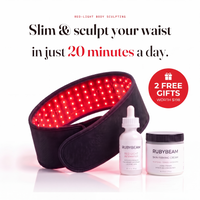
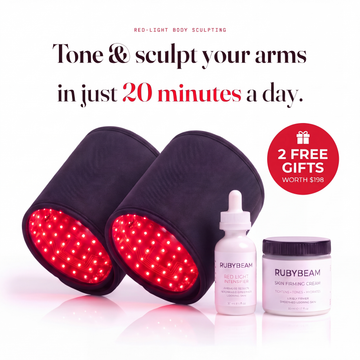
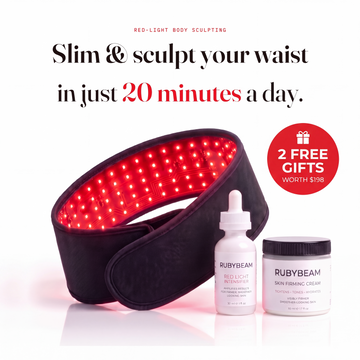
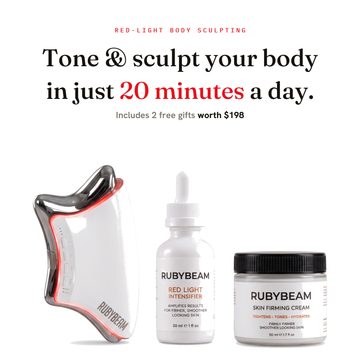
Everything above is the mechanism. RubyBeam is simply the delivery: 660 & 850 nm across 105 medical-grade diodes, in direct skin contact, with micro-current and far-infrared heat layered in — contoured so you can put the right dose exactly where you want it.
Which zone bothers you most?


Not sure where to start? Most people begin with the zone that bothers them most, then add a second once they see it work. Treating more than one area? The Full-Body Kit covers all four zones in one box — doubling up on the arms and thighs — for $399.99 (a $1,599.99 value).
The whole mechanism, in 20 minutes a day.
Each band pairs with a conductive Intensifier Serum that carries the light and current into the skin, and a Firming Cream that seals the result — the first set of both is included. Backed by a 30-day money-back guarantee, so you can test the science on yourself.
660 + 850nm · 105 diodes · USB-C · 2-year warranty · 30-day money-back